
Sour consumer, growth still on track

Read time: 7 minutes
So goes the consumer…is the longstanding phrase many are aware of; of course, the follow-on to this phrase is “so goes the economy.”
Consumption makes up about 70% of GDP. If consumers’ mood is sour, they tend to pull in their horns and slow spending growth. I have long held the view that any economic transaction needs the buyer to possess both the ability to transact and the willingness to do so. Without either of these factors in place, no transaction will take place.
Ability and willingness both important
Measuring consumer’s ability to consume is fairly easy—we have volumes of data pertaining to wage rates, savings rates, etc. But measuring the willingness to transact? What tools should we use to measure this softer input factor?
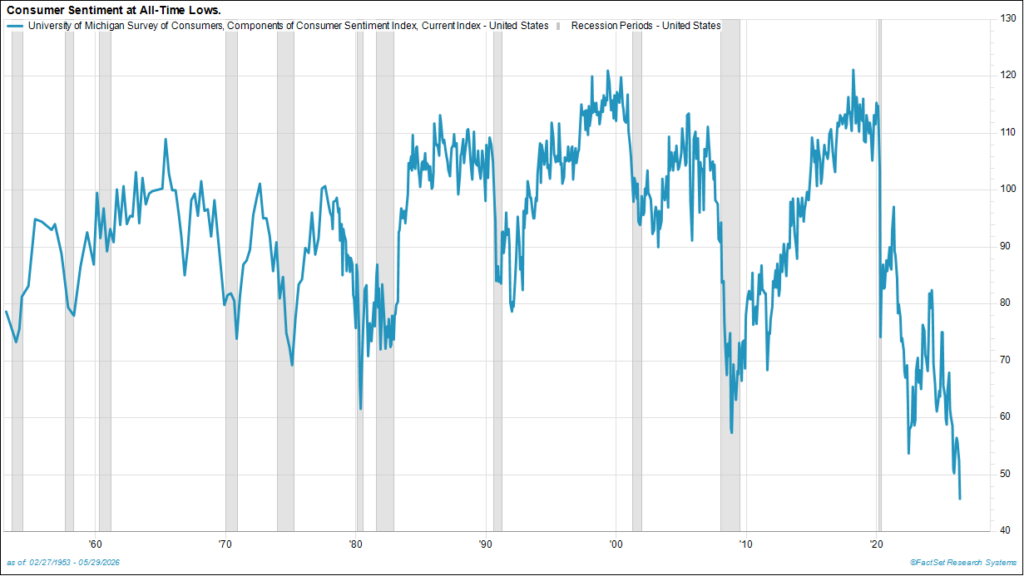
I turn to sentiment and confidence polls to guide me on the consumer’s willingness to consume. Consumers’ mood has never been as sour as is currently the case, according to the University of Michigan consumer sentiment index (see below). As noted, this data goes back to 1953; so, a new 73-year low in consumer sentiment has been reached.
Source: FactSet
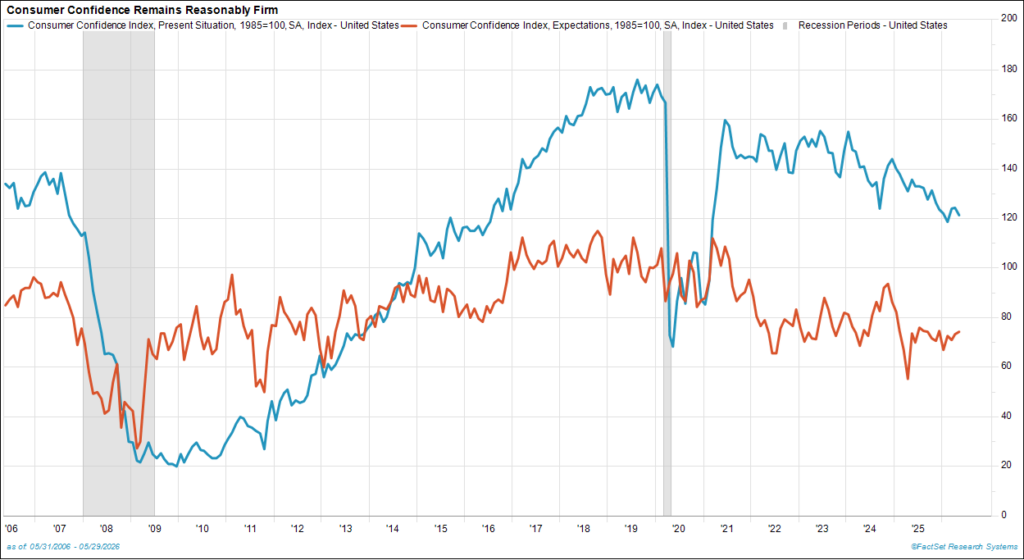
So, the University of Michigan sentiment index is at an all-time low. But wait—the National Bureau of Economic Research (NBER) Consumer Confidence index is showing us a different picture (see below). Confidence remains reasonably firm, while sentiment is poor.
Source: FactSet
Why the difference in the two survey’s outcomes? First, the University of Michigan sentiment survey asks people mostly about their own money situation. People sense that inflation is rising and it makes them nervous about their own financial future. As an example, rising gasoline prices play into the sentiment index.
The Consumer Confidence survey’s results and questioning are more tightly aligned with consumers’ view toward the jobs market. Currently, one can argue the jobs market appears to be rather balanced: job creation rates are slowly rising, and job eliminations have been low. So, the “Present Situation” outcome of the NBER’s confidence index, while recently softening slightly, is still strong, and nowhere near levels normally associated with meaningful economic stress.
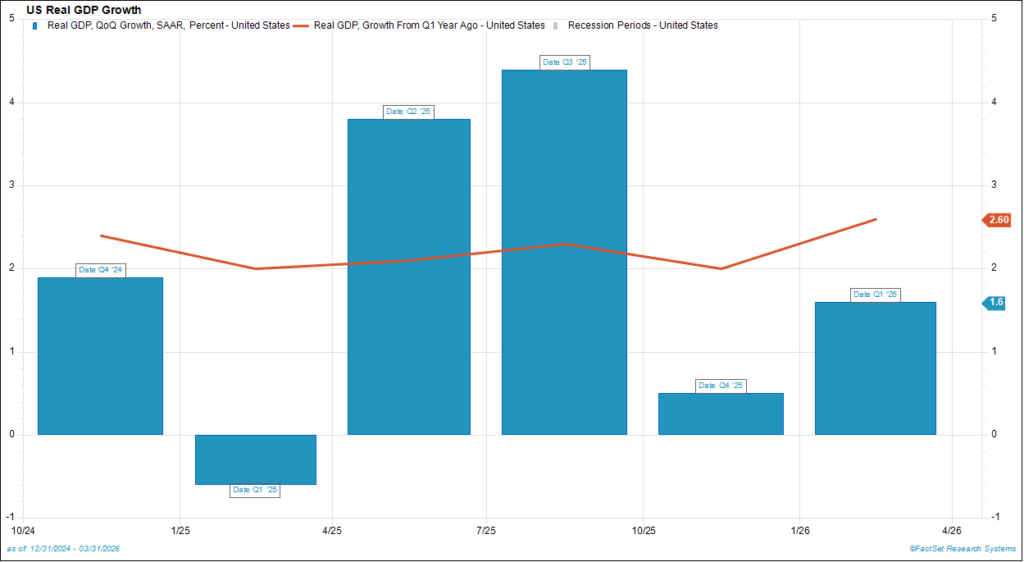
Importantly, the outcome of the NBER’s confidence survey is more in-line with the near-term macroeconomic outcome as measured by real quarterly GDP growth rates (chart below).
Source: FactSet
Consumers are, however, worried about the future. Future expectations are lower than their current situation, but this isn’t unusual, as this has been the case rather consistently over the last 10 years. I believe both the sentiment and confidence surveys need attention. While the sentiment survey is softer in the outcome, those sentiments reflecting consumer worry need to be addressed.
There are two factors which I believe are playing into the sentiment survey and aren’t necessarily included in the “Present Situation” outcome of the confidence index. Those two factors are:
- The political divide in the country where, according to a Gallup poll taken in 2024, 80% of U.S. adults believe the country is highly polarized.1 Separately, a Pew Research Center study found that 72% of Republicans and 63% of Democrats think members of the opposing party to be “more immoral” than most Americans.2 American consumers understand the political divide in the country and are worried about this political split.
- According to a report in the May 23 Wall Street Journal, Robert Barbera, former economist from Johns Hopkins, suggests artificial intelligence (AI) may help explain why consumer sentiment remains weak and consumers are in a nasty mood, despite the strength in the economy (and stock prices).3
AI may weigh on consumer sentiment
Let’s focus on the second bullet above: massive amounts of capital are being spent to develop and install AI capabilities. Many reports suggest that AI promises to boost worker productivity growth rates, but consumers by and large are worried about what path that productivity improvement takes. Will it cost them their jobs?
Headlines abound about how many of us may wind up unemployed as AI takes form and our employers deploy these computer-based models, which we all hope will make us work smarter but not eliminate our jobs. These factors play into the sentiment index and not directly into the confidence survey.
This dichotomy is also reflected in the stock market, which recently has been setting new highs. The market has been highly focused on AI deployment leading to enhanced worker productivity.
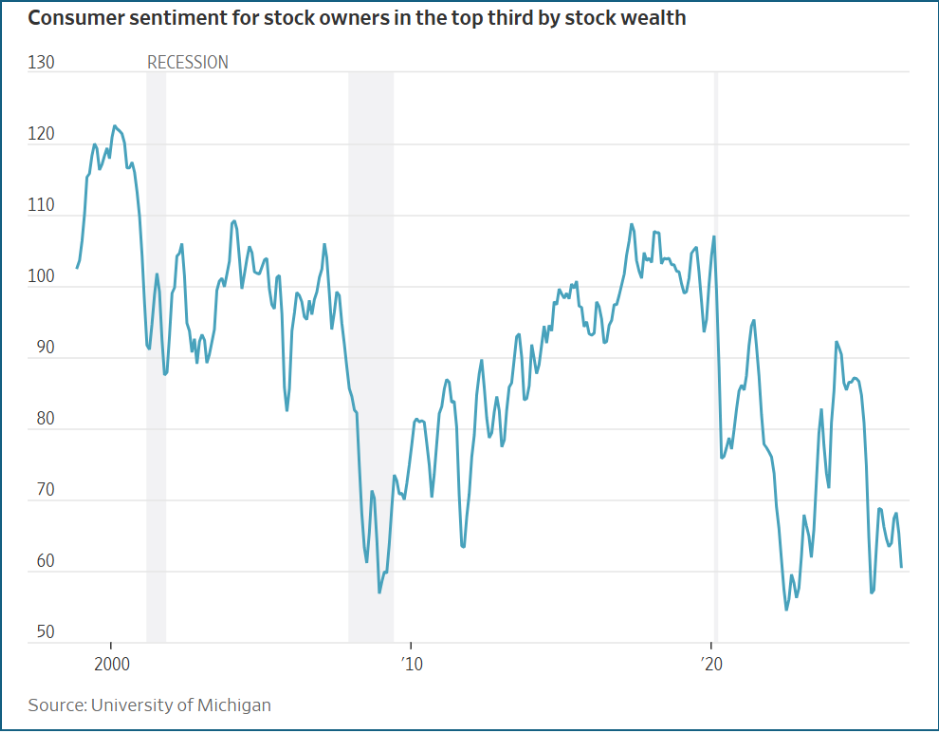
That said, the University of Michigan survey released their finding that folks who own stocks aren’t as negatively biased as those who don’t. Sentiment of consumers who own stocks is a reading of slightly above 60 (chart below) while in total, the index is now at 45 (first chart).
Source: University of Michigan
Déjà vu growth call on track
The proof of consumer spending activity lies in the numbers. During the first quarter of 2026, consumer spending increased at an annualized rate of 1.4%, slowing from the pace of spending growth in 2025 (see chart below). What about growth expectations going forward?
The Federal Reserve branches in New York and Atlanta both create estimates of current quarter GDP growth, using known releases up to this time. The average expected second quarter GDP growth rate between these two models is 3.5%. The first quarter GDP growth rate was 1.6%. Our core economic outlook for all of 2026 is calling for GDP growth of 2.5% to 3.0%. If the noted Fed modeling comes through, the first half 2026 GDP growth rate should be in the 2.6% range, in-line with our “Déjà vu” growth call.
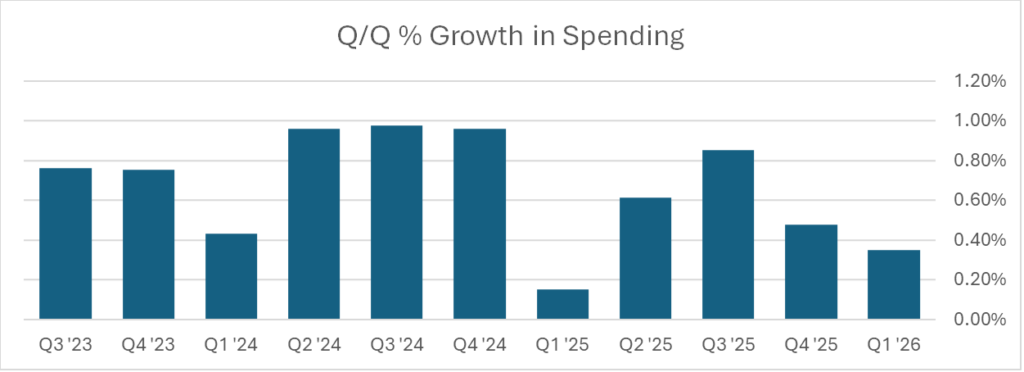
Data sourced from Bureau of Economic Analysis as of 3/31/2026 and represents the Q/Q% change of the Personal Consumption Expenditures Index.
Final word
We need to pay attention to both consumer sentiment and confidence surveys; they’re released monthly. We’ll monitor these polls along with all other relevant activities as we move forward.
Sources:
1. Gallup: https://news.gallup.com/poll/650828/americans-agree-nation-divided-key-values.aspx
2. Pew Research Center: https://www.pewresearch.org/politics/2022/08/09/as-partisan-hostility-grows-signs-of-frustration-with-the-two-party-system/
Wall Street Journal: https://www.wsj.com/economy/consumers/stock-market-consumer-sentiment-af088e87
This commentary is provided for informational and educational purposes only. As such, the information contained herein is not intended and should not be construed as individualized advice or recommendation of any kind.
The opinions and forward-looking statements expressed herein are not guarantees of any future performance and actual results or developments may differ materially from those projected. The information provided herein is believed to be reliable, but we do not guarantee accuracy, timeliness, or completeness. It is provided “as is” without any express or implied warranties.
There is no assurance that any investment, plan, or strategy will be successful. Investing involves risk, including the possible loss of principal. Past performance does not guarantee future results, and nothing herein should be interpreted as an indication of future performance. Please consult your financial professional before making any investment or financial decisions.
Mariner is the marketing name for the financial services businesses of Mariner Wealth Advisors, LLC and its subsidiaries. Investment advisory services are provided through the brands Mariner Wealth, Mariner Independent, Mariner Institutional, Mariner Ultra, and Mariner Workplace, each of which is a business name of the registered investment advisory entities of Mariner. For additional information about each of the registered investment advisory entities of Mariner, including fees and services, please contact Mariner or refer to each entity’s Form ADV Part 2A, which is available on the Investment Adviser Public Disclosure website. Registration of an investment adviser does not imply a certain level of skill or training.