
Anthropic and investing (or not) in IPOs

Read time: 6 minutes
By Jeff Krumpelman, Chief Investment Strategist & Head of Equitites, and Bryce LeRoy, Analyst, Equities
Anthropic, the maker of the Claude artificial intelligence (AI) models, is expected to go public this week in what could be the largest IPO in history. There is understandably a lot of excitement surrounding the new issue. Anthropic has an impressive history of growth and its future holds enormous growth potential, but growth alone does not guarantee a great investment. In this piece, we’ll take a look at Anthropic’s business and share historical data on the risks of investing in IPOs too soon.
Anthropic
Anthropic is expected to price its IPO on Nov. 18 and start trading on Nasdaq the next day under the ticker ANT. It’s aiming to raise roughly $64 billion, and with a separate private placement from partners such as Nvidia, Microsoft and Alphabet, the total could approach $90 billion, which would top SpaceX’s record offering earlier this year. Demand for the offering is extremely high, with the deal reportedly six times oversubscribed. The company is targeting a valuation of about $1.4 trillion, up from $965 billion in a private financing round just last May.
It’s easy to see why investors are so eager. Anthropic owns the popular AI tool Claude and sells it to businesses and individuals. Revenue was about $4.6 billion in all of 2025 and has already reached $33 billion in the first nine months of this year. The number of customers spending at least $100,000 a year has jumped from roughly 950 a year ago to more than 11,900 at the end of September. If businesses continue utilizing Claude in their daily work, the growth runway could be long. Some Wall Street banks are reportedly looking at revenue estimates of $685 billion by 2030.
Still, there are real risks to keep in mind. Anthropic leans on a handful of large customers and on cloud partners that are also competitors, and it has committed to hundreds of billions of dollars in computing infrastructure spending. AI regulation is another unknown.
When a new industry such as AI emerges, it can be easy to get excited about its growth potential, but it’s much more difficult to accurately predict the new industry’s winners. Airlines are the classic example of an industry that transformed how we all live, while creating very little value for shareholders in the process.
None of this means Anthropic won’t do well. But a great company isn’t automatically a great investment at any price, and the AI landscape continues to evolve.
IPO performance: Follow the data
Jay Ritter, a University of Florida finance professor widely known as “Mr. IPO,” has spent decades building the most comprehensive database of U.S. IPOs, going back to 1980. His data show a consistent pattern: Investors who get shares at the offer price often enjoy a quick gain, but those who buy once trading begins and hold for three years have usually lagged the market.
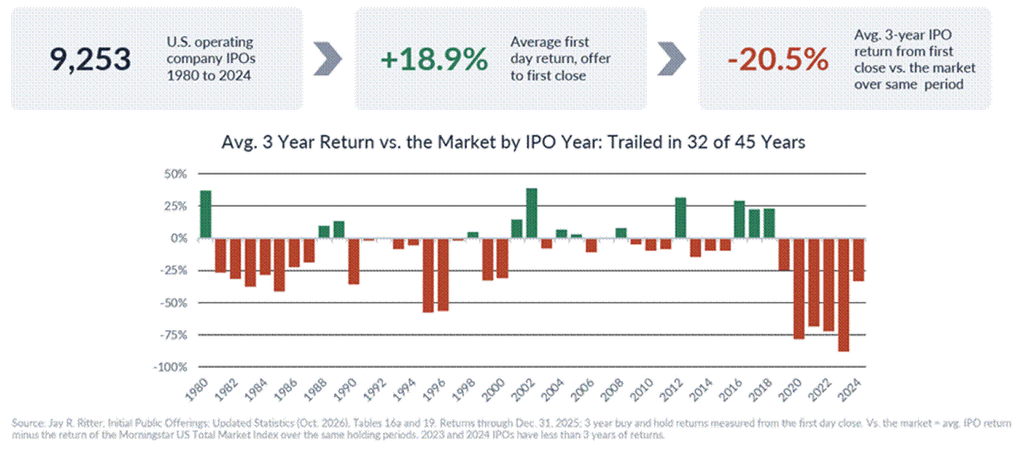
Across 9,253 IPOs, the average first-day gain from the offer price to the first closing price was 18.9%. But from that first close, the average IPO then trailed the market by 20.5% over the next three years. The first-day “pop” largely goes to the investors who receive allocations at the offer price. Nearly everyone else buys after it has happened.
Large, well-known companies, defined as those with at least $100 million in sales, don’t escape the pattern. Ritter’s data on 4,110 such IPOs show that the more expensive the IPO, as measured by price-to-sales multiples, the bigger the first-day excitement and the worse the performance is for the following three years.
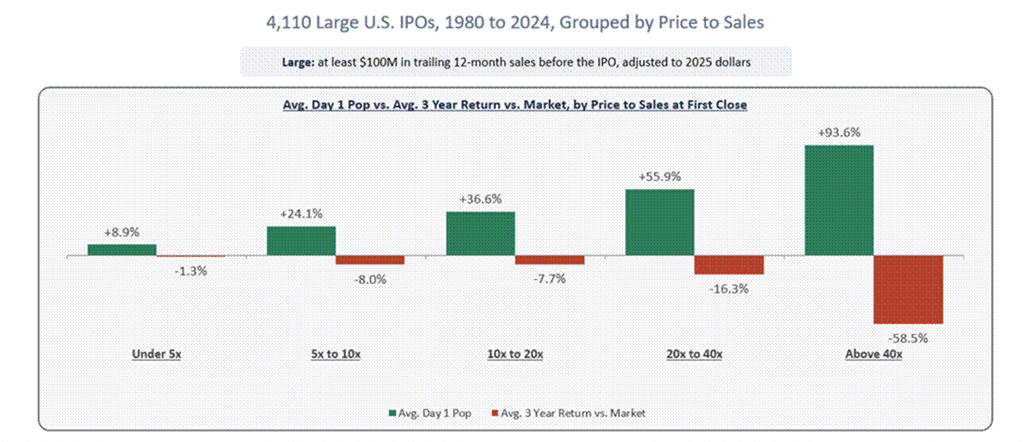
Every price-to-sales group trailed the market. Those priced above 40 times jumped 93.6% on day one, then lagged the market by 58.5% over three years. On our estimate, Anthropic sits around a price-to-sales multiple of 28, putting it into the second most expensive group.
What it means for investors
This is not a message to say that you should never invest in an IPO or that Anthropic is overvalued. It is meant to highlight that patience is often rewarded when it comes to investing in new issues.
Ritter’s evidence shows the base rates for participating in IPOs. In looking at the historical data that Ritter has compiled comprised of a universe of over 9,000 companies over the last 40 years, we are forced to conclude that IPO’s may be fascinating, may make for great cocktail conversation and may scratch that intellectual curiosity itch, but they aren’t very profitable investments on a relative return basis in the first several years of their publicly traded life.
Additionally, his work favors waiting until the early excitement has cooled, lock-up expirations have passed, analyst coverage has broadened and the company has a longer financial record. Investors should evaluate whether or not to buy based on fundamentals, valuation and technicals, rather than the hype and excitement surrounding the latest new thing. Fear of missing out (FOMO) is not a sound investment strategy.
This commentary is provided for informational and educational purposes only. It does not consider any individual’s financial circumstances, investment objectives or risk tolerance and should not be construed as individualized investment advice or a recommendation to buy or sell any security.
The opinions and forward-looking statements expressed herein reflect the authors’ views as of publication, are subject to change without notice and are not guarantees of future events or investment performance. Actual results or developments may differ materially from those discussed. Information is derived from sources believed to be reliable, but its accuracy, timeliness and completeness are not guaranteed.
All investing involves risk, including possible loss of principal. IPOs involve risks, including significant price volatility and limited liquidity. Historical IPO results reflect averages; individual results vary and may differ materially. Historical underperformance does not predict Anthropic’s results or establish an optimal purchase date. Waiting to invest may result in missed gains.
Mariner is the marketing name for the financial services businesses of Mariner Wealth Advisors, LLC and its subsidiaries. Investment advisory services are provided through the brands Mariner Wealth, Mariner Independent, Mariner Institutional, Mariner Ultra, and Mariner Workplace, each of which is a business name of the registered investment advisory entities of Mariner. For additional information about each of the registered investment advisory entities of Mariner, including fees and services, please contact Mariner or refer to each entity’s Form ADV Part 2A, which is available on the Investment Adviser Public Disclosure website. Registration of an investment adviser does not imply a certain level of skill or training.